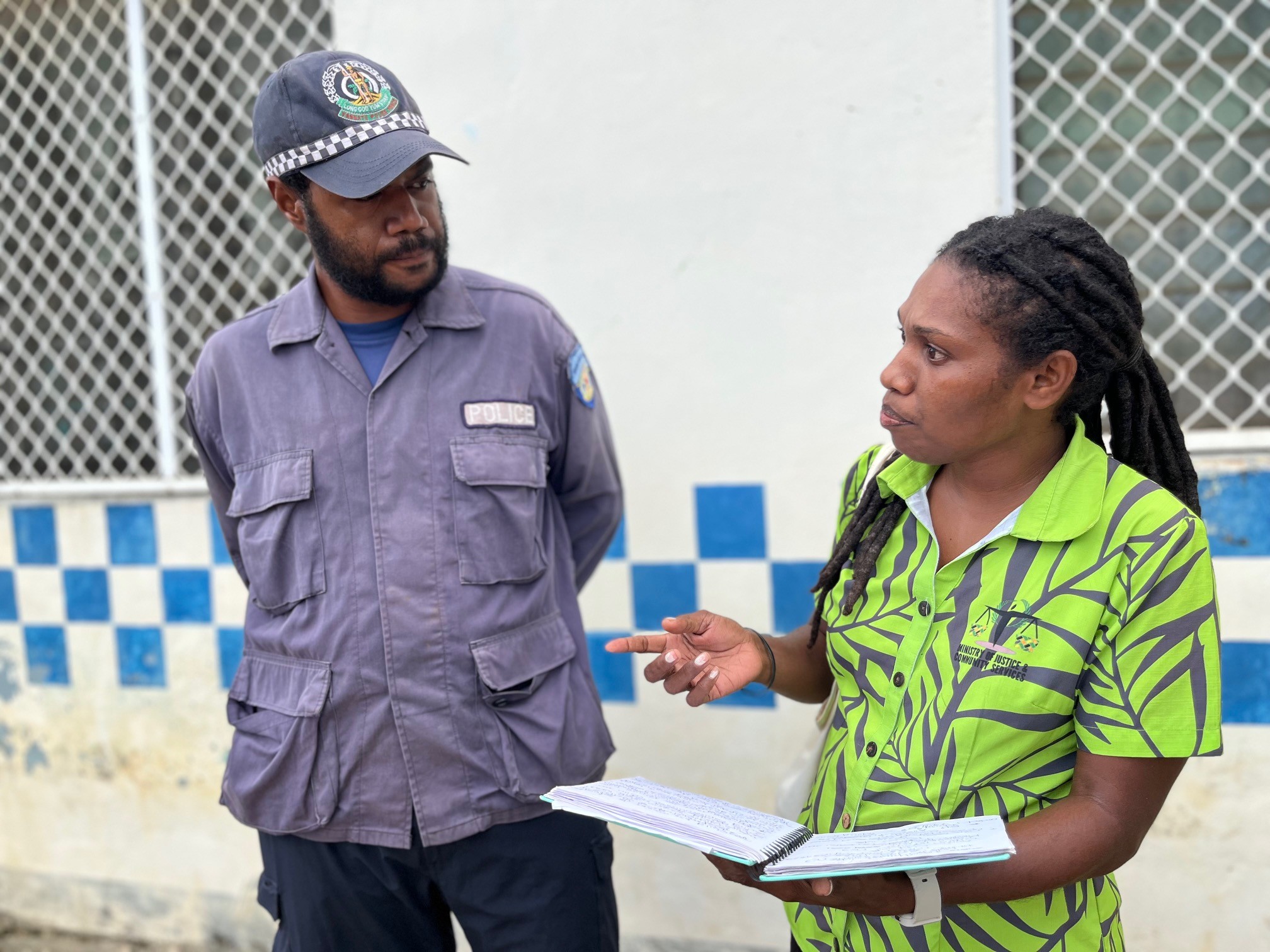
Sanma Province 29 April 2026: A child who survives sexual abuse in Sanma may be told to wait days for a forensic exam – and not to wash in the meantime – because the doctor only sees patients on Wednesdays.
For Esther Samson, the Child Protection Officer for Sanma, this is not an isolated failure. It is a sign of a system that is not holding.
When Esther talks about her work, she doesn’t lead with policy. She begins with memories – volcanic ash falling from the sky, cyclone winds tearing through communities – moments that revealed a hard truth: in Vanuatu, survival is not enough. Children need a system that protects them.
Right now, however, that system, including health services, police, social welfare, and the laws meant to connect them, is dangerously unstable.
Through Esther’s work, a hidden reality emerges. Child neglect is the most commonly reported issue in Sanma. But neglect is not confined to homes – it is embedded in the very systems meant to protect children. Without the Child Protection Bill, Esther is operating in a legal vacuum, where responsibility is unclear, and accountability is fragile.
She describes her role as “a canoe trying to navigate the open sea without an outrigger.” In the islands, we know what that means. Without an outrigger, even the strongest paddler will eventually capsize when the sea turns rough.
On the ground, the consequences are immediate and devastating.
There is the “Wednesday Barrier,” where a child must wait days for a medical examination, risking both evidence and dignity. There is the five-year-old beaten at home, where police walked away because of the father’s reputation. There is the 15-year-old girl denied the chance to give a statement because an officer decided she “knew what she was doing.”
“These children are small human beings,” Esther says. “They cannot handle everything. Instead of blaming them, we need to walk closely with them.”
That work – walking closely with children – is becoming harder by the day.
Esther travels long distances by boat to reach communities in Northwest Santo, responding to high-risk cases with limited resources. She works with limited resources, sometimes without basic tools like a functioning printer. More critically, she works without legal protection.
“We are just walking, but we don’t know when we are going to fall,” she says. “I am risking my life with these serious cases because there is nothing in place to protect me while I am in the field.”
Despite these constraints, her focus remains on the child in front of her. She knows her work is often misunderstood as simply talking about “rights.” But for her, rights are not abstract – they are about whether a child is safe.
“My job is to advocate for the best interests and welfare of the child – to make sure they are safe and protected.”
Sometimes, that advocacy begins on the floor.
“I introduce myself, be friendly, and tell them I am here to help,” she says. “Sometimes I ask what they did yesterday. We laugh together. After a while, they start smiling. They start talking to me even when I don’t ask anything.”
It is in these moments that trust begins.
But that trust is broken every time the system fails to respond.
The Child Protection Bill is the outrigger the canoe needs. It would provide a clear legal framework, define responsibilities across agencies, and ensure that when a child finds the courage to speak, the system is required to act.
For families in Sanma, this law is not a luxury. It is the difference between a child finding justice – or slipping through the cracks of a system that was never strong enough to hold them.